
The Silent Strategist Who Could Become Bengal’s Cabinet Minister: Know the man Delhi trusts for the toughest missions who may now be headed for Bengal
The Silent Strategist Who Could Become Bengal’s Cabinet Minister: Know the man Delhi trusts for the toughest missions who may now be headed for Bengal

Truth of Bengal: With the Bharatiya Janata Party (BJP) securing a historic mandate in West Bengal, the celebratory echoes in the streets of Kolkata have quickly transitioned into a high-stakes guessing game of who will occupy the key ministerial positions.The dust is about to settle as Union Home Minister Amit Shah is set to hold the strategic meeting today at the Biswa Bangla Convention Centre between 3 p.m. to 5 p.m.
The political “war room” is abuzz with the names of those who led the charge on the battlefield. Meanwhile a fascinating narrative is emerging from the corridors of power in New Delhi. The question before the BJP leadership is no longer just about who won the election, but who can navigate the sophisticated, often volatile, geopolitical and cultural landscape of this twenty-first century Bengal Renaissance.



Electoral victory and statecraft are not always the same enterprise. Hence, alongside the popular names like Suvendu Adhikari, Dilip Ghosh, Agnimitra Paul, Nisith Pramanik, Samik Bhattacharya, Sajal Ghosh, Dr.Sharadwat Mukherjee, Rupa Ganguly and Rudranil Ghosh who remain central to the BJP Bengal’s electoral victory, there are also talks of of those with technocratic expertise, as top contenders for the ministerial cabinet.

West Bengal today stands at a uniquely sensitive crossroads. The state faces economic stagnation, industrial decline, border-security complexities, communal polarisation, and deteriorating investor confidence. Simultaneously, West Bengal occupies an increasingly strategic position in India’s eastern and northeastern corridor — linked to Bangladesh, the Bay of Bengal, and the larger Indo-Pacific framework. Governing such a state may require not only political aggression, but also diplomatic sophistication, administrative composure, and international credibility.
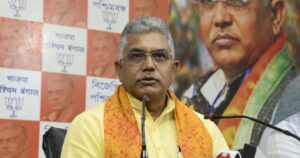
This is where the name of Harsh Vardhan Shringla enters the conversation with firmness.
Shringla is not your conventional firebrand politician. A former Foreign Secretary of India, he belongs to a rare class of Indian statesmen who have operated at the highest echelons of global power. Having served as India’s Ambassador to the United States, Bangladesh, and Thailand, and more recently as the Chief Coordinator for India’s successful G20 Presidency, Shringla’s resume is defined by “The Toughest Missions.”
For the BJP, elevating Shringla to the post of a cabinet minister would be a signal that Bengal is no longer just a political trophy, but a strategic gateway for India’s “Act East” policy.

The argument for Shringla heading some key ministry rests on several pillars. First, as West Bengal faces a steep climb out of industrial stagnation. Shringla’s international credibility and deep ties with global investors could act as a catalyst for the “Re-industrialization” of Bengal. Second, Shringla’s experience in neighborhood diplomacy makes him uniquely qualified to handle delicate complexitiesaround Bangladesh and the larger national security implications, as well as serving as the lynchpin to the Northeast. Equally important is his identity as a bhūmiputra of Darjeeling. Shringla’s familiarity with both the hills and the plains of North Bengal is not acquired — it is inherited, instinctive, and lived. This deep-rooted connection gives him an unusually nuanced understanding of the aspirations, anxieties, grievances, and socio-political currents that shape North Bengal.

There is precedent within the BJP for elevating technocratic figures into positions of enormous political significance. The party has often prioritised long-term strategic fit over immediate populist demand. While other leaders embody the victorious general of Bengal’s political battlefield, Shringla could emerge as the administrator capable of stabilising the territory after conquest.